 National
QUICK LINKS
Pro Tour Menu
Pro Tour Sponsors


SKUSA Partners


SEARCH
Next SKUSA Pro Tour Event
|
|
|


Best Bonus Slots on the Timing Sheet: How Slotester Grades Bonus Rounds on What They Paid
Anyone who has spent a weekend at a kart track knows the highlight lies. One heroic pass into the hairpin makes the video, and then the timing sheet shows a driver who was three tenths off the pace for the whole race. Slot bonus rounds have the same problem. Everyone remembers the free spins that paid a fortune and forgets the dozens that paid almost nothing. The best bonus slots ranking at Slotester ignores the highlight and reads the timing sheet: it pays the listed price for each game's bonus feature over and over, logs every result, and sorts the games by what those purchases actually returned. 
Why bonus rounds fool the eyeA bonus round is the part of a slot that sells the game. The music changes, the multipliers climb, and the occasional round pays hundreds of times the stake. It is also the hardest part of a game to judge from your own play, because a few sessions give you a handful of features at most. You remember the big one, you forget the six small ones before it, and the memory becomes your opinion of the game. Many modern slots also sell the feature directly through a bonus buy button: pay a fixed price, often 70 to 100 times your stake, and skip straight to the free spins. That turns the bonus into something you can measure like a lap time. Every purchase has a price and a result, and if you record enough of them you can say what the play actually returned instead of what it looked like on the replay. How the timing sheet is builtSlotester does its testing on each studio's own official demo server, using the free builds any player can load. Its rig plays a long base session at one fixed stake and logs every server response. Where the game sells its feature, the rig also presses the buy button a series of times in a row at the standard price, in the same session and at the same stake, and records what every single purchase paid. The ranking value is simple: the mean return of those purchases divided by the price. At 1.00x the buys paid for themselves exactly. Below 1.00x they cost money. Above it, the feature came out ahead in that run. A figure of 1.19x means the purchases returned 19% more than they cost; 0.83x means they returned 17% less. Only the standard buy option is used, so games are compared on the same footing, and premium "super" tickets are kept out of the numbers. Games without a buy button still appear in the table, ranked after the ones with a measured buy value. For them the lab counts natural triggers from the base run, how often the feature arrived on its own, and what those rounds paid on average. The same base runs feed Slotester's RTP ranking, so the two lists never disagree about a game's numbers, only about what to sort by. 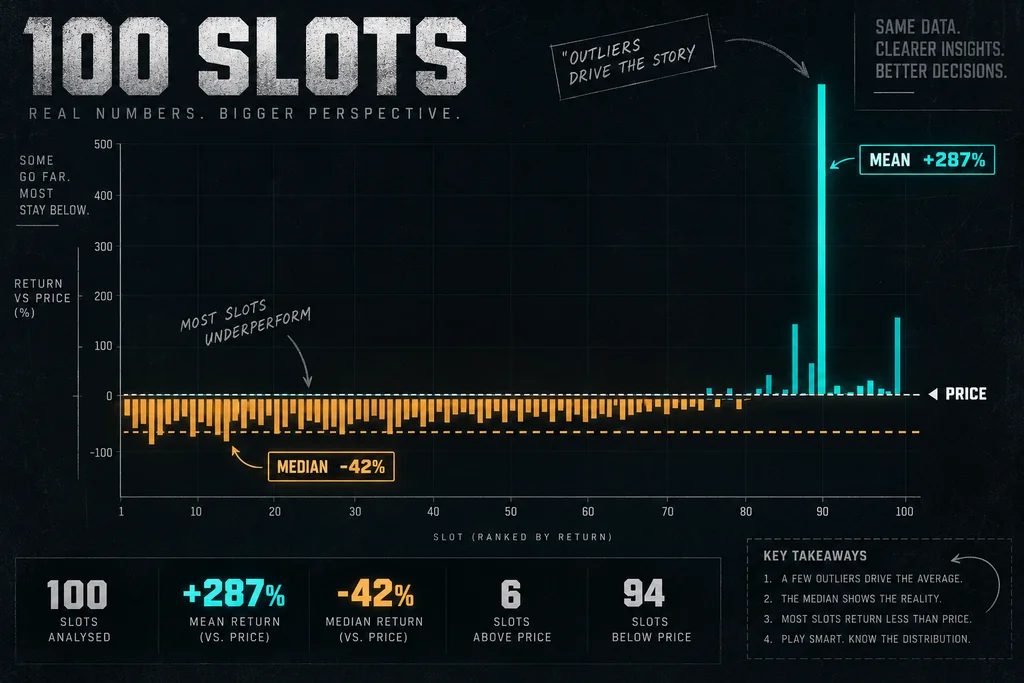
Mean, median and the losing ticketsAny race engineer knows that one tow down the back straight can flatter a driver's best lap while the average lap tells another story. Bonus buys work the same way, which is why every review shows more than the mean. The lab also publishes the median purchase, the number of purchases that lost money, the best and the worst, so you can see whether a game's average comes from steady returns or from one monster round. That distinction is the real value of the ranking. Two games can both sit near 1.0x while behaving completely differently. One might return around 0.9x on almost every ticket. The other might return 0.2x on a typical ticket and make it up with a rare 40x. On the timing sheet they look similar; on track they feel like two different classes. The review pages print the whole ledger so you can pick the shape you can actually afford. The current leadersAt the top of the bonus ranking at the time of writing sits Tombstone R.I.P from Nolimit City at 1.39x, with Gates of Olympus Xmas 1000 close behind at 1.38x, followed by Sword of Ares at 1.35x, Chilli Heat Megaways at 1.29x and Madame Destiny Megaways at 1.26x. These are measurements of specific runs, and the table re-sorts automatically whenever a game is tested or re-tested. A second run of the same game can land on the other side of the 1.0x line. Game film: one slot, one hundred ticketsThe full Tombstone R.I.P report is the best example of why the median matters. The game is a western with five reels in a 2-3-3-3-1 layout and 108 ways to win, and its client rates the volatility at 10.0, labeled "Insane". The lab ran it twice at a fixed 1.00 demo stake, 10,000 spins each time, and bought its Hang 'em High free spins 100 times at 70 times the stake, 70.00 a ticket. Those 100 tickets cost 7,000 and returned 9,727.60, a 1.39x return on price. That is the headline. The lap-by-lap data underneath is far less glamorous. The median ticket paid just 11.60, about one sixth of its price. Eighty-two of the 100 tickets came back below what they cost, and ten returned nothing at all. Only 12 tickets paid double their price or more, and six passed five times. 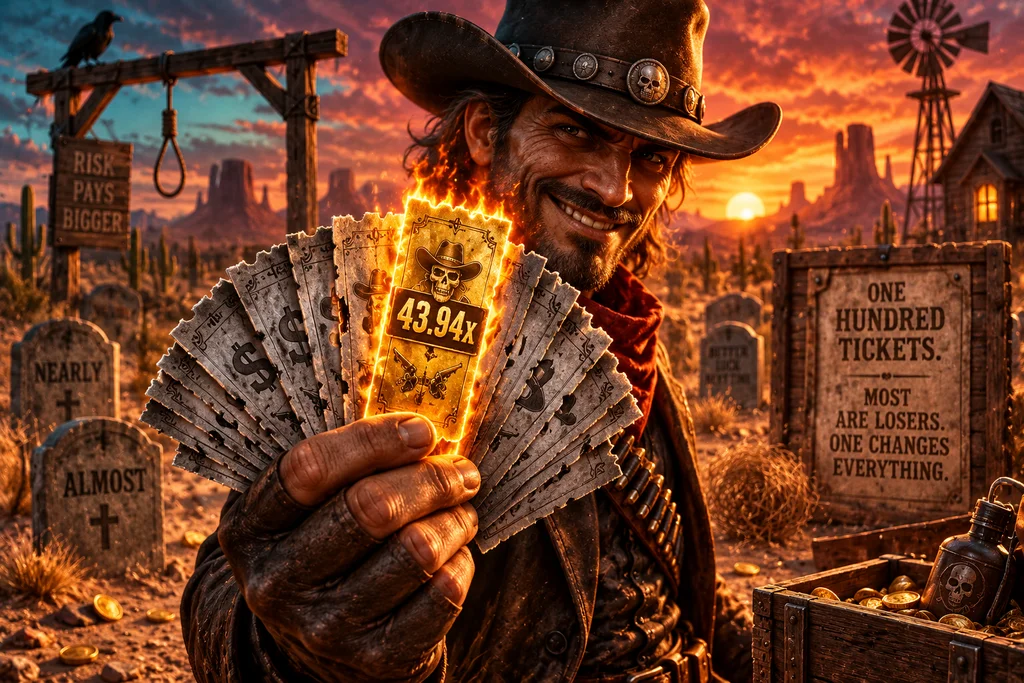
One ticket carried a large share of the result. Ticket 17 of the second run was upgraded mid-feature by a Boothill Scatter, which adds two spins and switches the rest of the round into a far more aggressive mode. It returned 3,076.10, almost 44 times its price, nearly all of it from the Boothill spins. In the first run, where no ticket was upgraded, the purchases averaged 0.91x. In the second they averaged 1.87x. Same game, same price, same stake: the difference was one rare event. The rule that wipes small winsTombstone R.I.P also shows why reading the rules matters. Its xRIP mechanic voids any spin whose wins add up to less than the base bet, in the base game and in the free spins alike. Across the first 10,000 spins it wiped 1,836 small wins, about twice as many as the 909 spins that actually paid. In practice that means long dry spells: the longest ran 73 spins, and droughts of 30 spins or more came 113 times across 20,000 spins. The natural feature arrived about once every 179 spins and paid an average of 92 times the stake, but its median was 18.1x, and 58 of 112 natural features paid under 20x. Over both runs the base game returned 103.79% against a declared 96.08%, but the first run alone came in at 66.69%, and the combined series fell 3,589 bets below its starting point before one huge round turned it around. That is the profile of a game for players who accept very long losing stretches in exchange for a rare, enormous result. Every ticket has its own price tagOne detail most players never check is that a bonus buy carries its own return figure, separate from the base game. Tombstone R.I.P lists 96.08% for regular play, 96.47% for the 70x Hang 'em High ticket and 97.03% for a 3,000x ticket that goes straight to Boothill, which the lab did not buy. The game also caps any single round at 300,000 times the stake, a result the studio says it simulated about once in 130 million rounds. Those numbers come from the game's own rules screens, and the lab's review quotes them next to the measured results so you can see both the design and the reality on one page. Buy the feature or wait for it?Buying is the loud way into a bonus and waiting is the quiet one. A bought feature is priced so that, over enough purchases, it returns a little less than it costs: the buy has its own RTP, usually within a fraction of a point of the base game. A 100x purchase on a game that triggers naturally about once every 200 spins costs roughly what those 200 spins would have cost, minus the small wins you would have collected along the way. What the buy cannot purchase is a smoother ride. A natural trigger lands on top of whatever your balance was doing. A purchase replaces two hundred small results with one big one, so a session built on buys swings much harder and can end much faster. Players who want to see the feature choose the buy; players who want the session to last choose the wait. The ranking shows both routes side by side, with natural triggers in one column and purchase returns in another. How to read the leaderboardA game at 1.2x in the lab's run is not a discount waiting to be collected. It is a game whose purchases happened to include a large round. A game at 0.8x is not broken; its large round simply did not show up in that sample. A few dozen buys are far fewer than the volume needed for the true long-run price to appear. So use the ranking for what it does well: it shows the shape of a feature, how often it pays little, how often it pays big, and how deep the losing stretches get. 
Play within your limitsBonus buys raise the stakes fast, which makes limits more important, not less. A single ticket on a 70x game costs as much as 70 ordinary spins, and the Tombstone R.I.P data shows that most tickets lose. Set a budget before you start, treat it as the cost of entertainment, and stop when it is spent. Never chase losses, never use money meant for rent or bills, and make use of the deposit limits, cooling-off periods and self-exclusion tools that licensed casinos provide. Gambling is for adults only. If it stops being fun, free confidential help is available, including the 1-800-GAMBLER helpline in the United States. Chequered flagThe highlight will always sell a slot's bonus round, just as one late lunge sells a race. The timing sheet is what tells you who was actually fast. By paying full price for each feature again and again, logging every result, and printing the median and the losing tickets next to the average, Slotester's bonus ranking gives players the full timing sheet rather than the onboard clip. |